Author: Site Editor Publish Time: 2026-09-28 Origin: Site
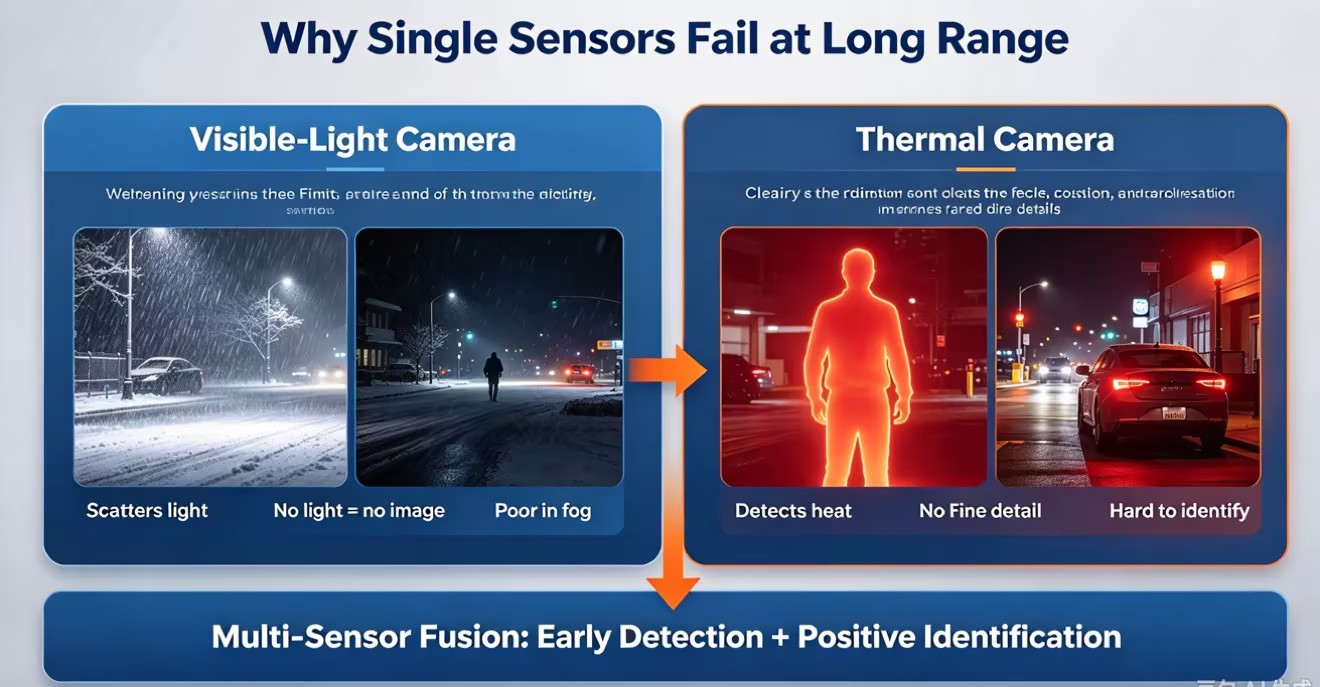
Securing expansive perimeters and critical infrastructure requires threat detection capabilities that extend far beyond the physical fence line. Security teams routinely monitor miles of unlit or obscured terrain. Relying on single-sensor security creates blind spots across these vast areas. Optical cameras fail entirely in low light and heavy fog. Conversely, standalone thermal cameras lack the granular visual detail required for positive target identification and evidentiary documentation. A Multi-Sensor EO/IR camera bridges this operational gap by fusing high-definition visible light and thermal data into a single unified feed. This guide breaks down the technical criteria, integration requirements, and operational trade-offs necessary to evaluate and deploy a multi-sensor system for long-range target tracking. You will learn how to structure your security architecture to ensure security teams have ample time to respond to threats long before a physical breach occurs.
Sensor Synergy is Non-Negotiable: Effective long-range security requires both thermal imaging for early detection and high-zoom EO sensors for positive identification.
DRI Metrics Dictate Procurement: System selection must be anchored in standardized Detection, Recognition, and Identification (DRI) ranges based on Johnson’s Criteria, not generic "long-range" marketing claims.
Integration Amplifies Value: The highest ROI comes from systems capable of "slew-to-cue" automation, where ground radar or perimeter sensors automatically direct the EO/IR camera to a target's exact coordinates.
Maintenance Realities: High-end cooled thermal sensors offer superior range but introduce strict maintenance lifecycles (cryocooler servicing) that must be factored into the Total Cost of Ownership (TCO).
When you mount a standard visible-light camera on a 40-foot pole to watch a fence line two miles away, weather dictates your success. Rain, fog, and snow physically scatter visible light particles. This scattering drops image contrast to zero and completely hides distant targets. If you operate in zero-light conditions, optical sensors become dead weight without active illumination. You can add floodlights or infrared illuminators for short distances. However, illuminating a target three kilometers away remains physically impossible for standard security infrastructure. You cannot rely on optical sensors alone for early warning detection across large open spaces.
Thermal security cameras solve the initial detection problem. They detect targets based purely on emitted heat signatures, ignoring visible light entirely. A thermal sensor reads the minute temperature differences between a human body and the surrounding environment. This process works in pitch-black darkness or heavy maritime fog. Yet, thermal imaging carries a hard operational limit. It cannot capture text, facial features, or specific clothing colors. You cannot read a license plate or a ship's hull number using thermal video. You cannot determine if an approaching intruder wears a specific uniform. This lack of visual detail complicates rules of engagement and forces security teams to guess during law enforcement hand-offs.
Dual-sensor and multi-sensor payloads operate simultaneously to eliminate these specific blind spots. Operators detect anomalies thermally at extreme ranges. They then instantly verify those same anomalies optically using high-powered zoom lenses. This simultaneous operation provides complete situational awareness. You gain the early warning capabilities of thermal detection alongside the evidentiary clarity of optical video.
Long-range identification demands continuous optical zoom capabilities. Systems require optical zoom ranges from 30x up to 135x or higher. Digital zoom merely enlarges existing pixels and severely degrades image quality, making it useless for identifying a suspect at two kilometers. Continuous optical zoom physically moves glass elements inside the lens barrel to magnify the target while maintaining full sensor resolution.
Low-light performance depends heavily on physical sensor size and pixel pitch. Larger CMOS sensors, such as 1/1.8-inch formats, capture significantly more photons than smaller 1/2.8-inch sensors. This photon gathering dictates twilight and dawn operational clarity. Near-infrared (NIR) sensitivity allows the sensor to utilize ambient moonlight effectively, extending the usable hours of the optical camera before switching entirely to thermal.
Atmospheric penetration remains a major hurdle for optical sensors. Maritime haze, high humidity, and heat mirages distort distant images. Advanced optical defog filters physically block specific light wavelengths that scatter in moisture. Digital image processing algorithms then enhance contrast dynamically. This combination cuts through environmental interference to reveal hidden details.
| Optical Focal Length | Typical Application | Field of View Characteristics |
|---|---|---|
| 15mm - 50mm | Short-range perimeter monitoring | Wide angle, excellent situational awareness, poor distant detail. |
| 50mm - 200mm | Medium-range tracking | Balanced field of view, suitable for tracking vehicles at 1-2 km. |
| 200mm - 500mm | Long-range identification | Narrow field of view, requires stabilization, identifies humans at 3+ km. |
| 500mm - 1000mm+ | Extreme long-range border/coastal | Extremely narrow, highly susceptible to wind vibration, extreme detail. |
Uncooled thermal sensors work within the 7–14 µm long-wave infrared band. They change resistance when absorbing infrared energy and have no built-in cooling parts, so maintenance needs are low. They are ideal for short and medium-range perimeter security and can reliably detect targets several kilometers away. Cooled thermal detectors operate in the 3–5 µm mid-wave infrared range. A built-in Stirling cryocooler cools the sensor to very low temperatures to cut internal thermal noise, supporting ultra-long-range detection over 10 km. They are necessary for tracking small fast targets such as drones along wide borders and coastlines. Thermal resolution also affects long-distance clarity: common 640×480 sensors can be upgraded to 1024×768 or 1280×720 high-definition versions, and more pixels on target extend detection range. Fixed lenses work for medium wide-area monitoring, while continuous zoom thermal lenses over 1000mm suit extreme long-range tracking. When selecting sensor types, assess required detection distance, target size, maintenance manpower, mounting weight/wind limits and on-site power supply for cooling units.
Built-in laser rangefinders (LRF) calculate target distance by sending laser pulses and measuring return time. This distance data supports precise GPS positioning, helps tracking software forecast target movement and auto-adjust focus. Combined with mapping tools, security staff can get the exact location of intruders. Other active components include synchronized infrared illuminators and laser pointers. IR illuminators cast invisible infrared light for covert night-time optical tracking when ambient light is insufficient. Visible laser beams from laser pointers help response teams locate hidden intruders on site.
System selection must rely on standardized metrics, specifically Johnson’s Criteria. This standard defines the specific number of pixels on target required to perform three distinct tasks. Detect means realizing an anomaly is present. Recognize means classifying the object as a human versus an animal. Identify means confirming specific details, such as identifying an armed intruder.
| Operational Phase | Pixels on Target Required | Actionable Outcome |
|---|---|---|
| Detection | 1.5 to 2 Pixels | Operator confirms an object is present in the field of view. |
| Recognition | 6 to 8 Pixels | Operator classifies the object type (e.g., human, vehicle, animal). |
| Identification | 12 to 14 Pixels | Operator determines specific characteristics (e.g., uniform type, weapon presence). |
You must read manufacturer specification sheets critically. Vendors often calculate DRI ranges based on ideal laboratory vacuums or perfectly clear days with zero humidity. Real-world atmospheric conditions reduce these ranges significantly. Always demand DRI calculations based on your specific regional humidity, average weather patterns, and the specific thermal contrast of your expected targets.
When cameras work at maximum zoom, small vibrations become highly noticeable. Wind shaking on tall poles can make unstabilized video unusable for long-range monitoring. Gyro stabilization is essential: mechanical stabilization separates the camera from its mount via built-in gyros and motors, while electronic stabilization digitally reduces shaking but cannot replace mechanical stabilization. Pan-tilt units support full 360° rotation and fast movement to track quick targets such as drones. Precise positioning is critical, as even a tiny angle error will make the camera miss distant targets at 5 km. Direct-drive brushless motors remove gear play from older belt designs and deliver the fine positioning accuracy required for high zoom.
Today’s security systems run AI processing locally on cameras instead of central servers. Edge AI instantly classifies humans and vehicles, and automatic tracking algorithms control pan-tilt motors to keep targets centered without manual joystick operation. These AI tools filter false triggers caused by swaying trees, rain or animals to cut false alarms and reduce operator workload. Connected to IoT systems, the camera can trigger automatic responses after confirmed thermal detection, such as turning on perimeter lights, activating audio warnings or locking access gates before intruders reach inner fences.
Multi-layer perimeter security connects ground security radar with multi-sensor cameras. The radar continuously scans wide areas and detects moving objects no matter the weather or visibility, while the camera serves to verify alarms. In the automatic slew-to-cue workflow, radar spots a moving target, computes its precise location, and sends coordinate data to the camera. The camera automatically adjusts pan, tilt and zoom, quickly turns toward the target and locks onto it. Security operators then get instant alerts and high-definition video for target confirmation, removing the need for constant manual screen monitoring.
Open standards are essential for enterprise system integration. The camera must support ONVIF Profile S, G and T to connect smoothly with mainstream video management systems such as Milestone and Genetec. Closed proprietary protocols restrict system expansion and tie users to one vendor. Modern systems merge optical and thermal data, supporting picture-in-picture or blended overlay views to show heat signatures over regular video. The fused footage can be saved as evidence for incident reviews and official reports for law enforcement.
For government, protection and critical infrastructure sites, NDAA compliance is required, which demands approved chipsets and secure supply chains; non-compliant hardware carries supply-chain risks and possible backdoor threats. Since these edge cameras are placed outside secure boundaries and vulnerable to physical network tapping, you need robust cybersecurity measures: enable 802.1x port authentication, use HTTPS for web access, require encrypted firmware updates, and turn off unused ports and services on the camera to block attacks.
Before purchasing multi-sensor cameras, clarify your core usage scenarios. Security-oriented models focus on threat detection, tracking and visual identification for perimeter protection. In contrast, radiometric thermal devices are designed for precise pixel-level temperature measurement, mainly used for industrial inspection, leak detection and equipment troubleshooting. For regular security monitoring, radiometric functions bring extra calibration work and maintenance costs and are unnecessary.
Cooled thermal cameras provide ultra-long detection distances but need regular professional maintenance. Their built-in cryocoolers wear out after 10,000 to 20,000 working hours and require factory overhaul, so spare devices are needed for continuous operation. Uncooled thermal sensors have no wearable moving parts, offering higher reliability and being ideal for remote sites with difficult maintenance access. Additionally, multi-sensor cameras are heavy and need sturdy mounting structures, dedicated high-power supply lines and high-bandwidth networks to ensure stable operation.
Running dual high-definition optical and thermal video streams consumes large network resources. Adopting H.265 encoding can save nearly 50% bandwidth compared with H.264 while retaining clear image quality, which suits wireless and cellular network transmission. Dynamic bitrate adjustment and dual-stream settings further optimize network pressure: the system uses low-bitrate live streaming for real-time monitoring and saves high-resolution footage locally to ensure both smooth viewing and complete evidence recording.
Audit your perimeter to identify specific blind spots and measure the exact maximum line-of-sight distances required for detection.
Request unedited, raw video footage from vendors demonstrating their cameras operating in rain or fog at your required distances.
Verify your existing mounting poles can handle the physical weight and wind load of a multi-sensor payload without flexing.
Confirm your network infrastructure supports the bandwidth required for streaming simultaneous high-definition optical and thermal feeds.
A: Dual-sensor typically refers to one optical and one thermal lens housed together. Multi-sensor includes these primary lenses plus additional active payloads. These payloads often include laser rangefinders, near-infrared illuminators, laser pointers, or secondary wide-angle situational awareness lenses.
A: A laser rangefinder measures the exact distance to a target. The camera uses this distance data alongside its pan and tilt angles to calculate the target's precise GPS coordinates. This enables accurate tracking and allows security teams to dispatch guards to an exact location.
A: Cooled thermal cameras use a mechanical cryocooler to chill the sensor to cryogenic temperatures. This cooler contains high-speed moving pistons and seals. These mechanical parts wear down over time and require factory rebuilding every 10,000 to 20,000 hours of operation.
A: Slew-to-cue is an automated integration between a detection sensor and a camera. When a ground radar or fence sensor detects an intrusion, it sends the coordinates to the camera. The camera automatically turns (slews) to look exactly at that location (the cue) without human input.
A: No, thermal cameras cannot see through standard glass. Glass reflects infrared radiation. If you point a thermal camera at a window, you will only see the thermal reflection of the objects on your side of the glass, not what is inside the building.
A: Fog consists of suspended water droplets that scatter visible light. This scattering drastically reduces image contrast and blocks distant details. Advanced electro-optical sensors use optical defog filters and digital contrast enhancement to partially cut through light fog, but heavy fog requires thermal imaging.